
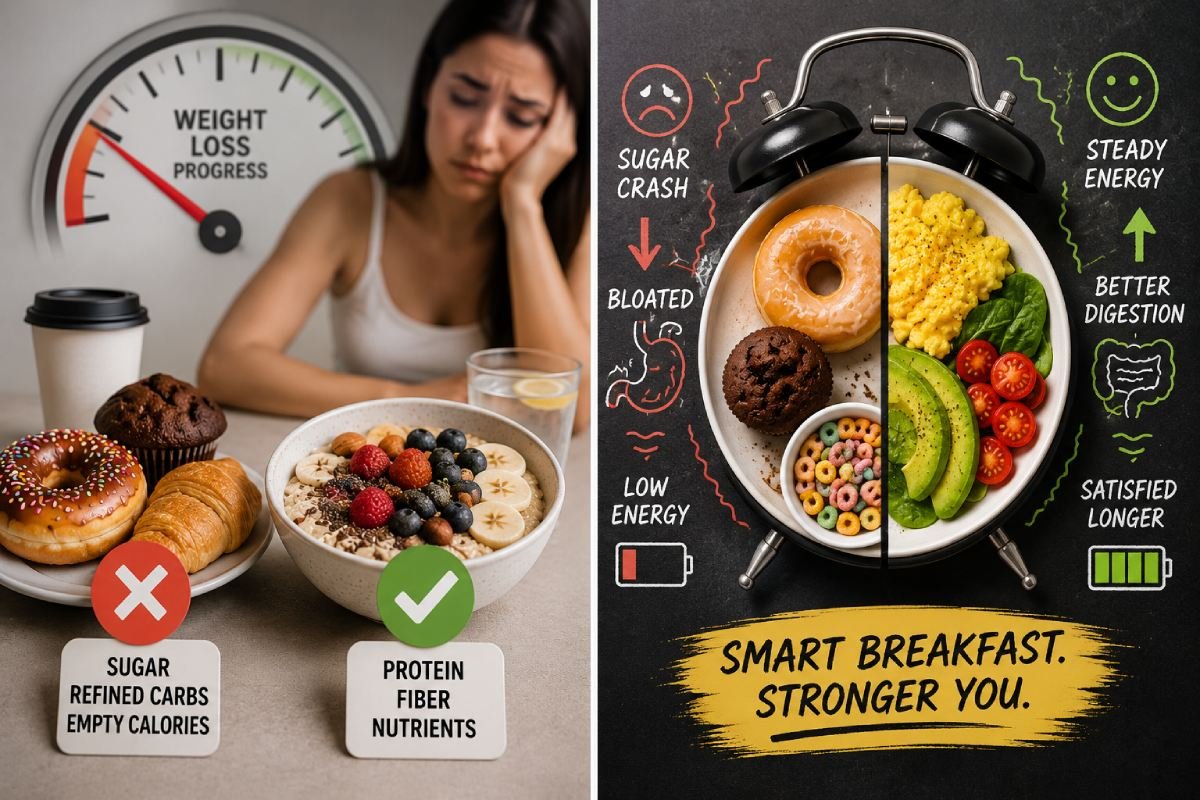
Breakfast often gets labelled as the “most important meal of the day.” But when it comes to weight loss, simply eating breakfast isn’t enough. What you eat, how much you eat and how balanced the meal is can make a bigger difference.
I often see people trying to lose weight begin their morning with the best intentions. They may skip breakfast altogether, eat only fruit, have a smoothie that is surprisingly high in calories, or choose something labelled “healthy” without checking what it actually contains. With guidance from the best dietitian in dubai, it becomes easier to understand which breakfast choices truly support your weight-loss goals.
The issue isn’t breakfast itself. The problem is that certain common breakfast habits can leave you feeling hungry shortly after eating, increase cravings later in the day, or quietly add more calories than you realise
So, if your weight has been stuck despite making an effort, it may be worth taking a closer look at your first meal of the day.
Small changes to your morning routine can make your overall eating pattern easier to manage.
Here are some of the most common breakfast mistakes I see
1. Skipping Breakfast and Eating Almost Anything Later
Skipping breakfast isn’t automatically bad for everyone. Some people genuinely aren’t hungry in the morning and can comfortably eat their first meal later.
The issue arises when skipping breakfast leads to extreme hunger by lunchtime.
You may find yourself eating quickly, choosing larger portions or reaching for high-calorie foods because you’re simply too hungry to make a thoughtful choice.
If you’re hungry in the morning, don’t ignore it. Have a proper meal. If you’re not hungry, you don’t necessarily need to force yourself to eat just because it is breakfast time.
The goal is to understand your hunger pattern rather than follow a rigid rule.
2. Having a Breakfast That Is Mostly Carbohydrates
Poha, upma, bread, cereal, idli and dosa can all be part of a healthy diet. The issue is when your breakfast contains mostly carbohydrates with very little protein or fibre.
For example, a large bowl of poha without any protein source may not keep you satisfied for very long.
A better approach is to combine carbohydrates with protein, vegetables, healthy fats or fibre.
Think of
- Vegetable poha with sprouts or peanuts
- Moong dal chilla with paneer
- Vegetable dosa with sambar
- Eggs with vegetables and whole-grain toast
- Greek yogurt with fruit and seeds
This creates a more healthy balanced breakfast rather than a meal centred around one nutrient.
3. Assuming Every Smoothie Is a Weight-Loss Smoothie
Smoothies can be a convenient and nutritious breakfast, especially on busy mornings or for those who prefer something light and easy to consume. They can also be a simple way to bring together protein, fruits, vegetables, healthy fats and other important nutrients in one meal.
However, the ingredients and quantities still matter. A smoothie made with banana, dates, peanut butter, nuts, seeds, milk, protein powder and honey may sound nutritious, but combining several calorie-dense ingredients can quickly increase its overall calorie content.
This doesn’t mean you need to avoid smoothies while trying to lose weight. Instead, focus on building them thoughtfully and keeping the portions appropriate for your individual needs.
Include a good protein source, some fruit or vegetables, a suitable liquid and a controlled amount of nuts or seeds. When planned well, a smoothie can be a nutritious, satisfying and convenient part of a weight-loss diet.
If you’re looking for healthy breakfast ideas for weight loss, a well-balanced smoothie can certainly be one of them.
4. Choosing “Healthy” Foods Without Checking Portions
One of the most overlooked breakfast mistakes is assuming that healthy food can be eaten in unlimited quantities.
Nuts, seeds, nut butters, granola, avocado and dried fruits can all provide valuable nutrients. But they are also energy-dense.
A handful of nuts can easily become two or three handfuls when you’re eating while working or scrolling through your phone.
Healthy doesn’t mean calorie-free.
Portion awareness still matters, particularly when your goal is weight loss.
5. Making Breakfast Too Low in Fat
The opposite extreme can also be a problem.
People sometimes search for low fat breakfast ideas and end up removing almost every source of fat from their meal.
There is no need to fear dietary fat. Foods such as nuts, seeds and eggs can provide important nutrients and help make a meal more satisfying.
The key is quantity.
Instead of completely eliminating fat, include a moderate amount as part of an overall balanced meal.
A nutritious breakfast doesn’t need to be fat-free. It needs to be appropriately portioned and nutritionally balanced.

6. Eating Only Fruit
Fruit is healthy, but fruit alone may not be enough for breakfast for many people.
A bowl of fruit provides carbohydrates, fibre, vitamins and minerals, but it is relatively low in protein.
If you’re hungry again an hour or two later, that can make it harder to manage your appetite throughout the day.
Try pairing fruit with a protein-rich food.
For example
- Fruit + Greek yogurt
- Fruit + eggs
- Fruit + cottage cheese/paneer
- Fruit + a controlled portion of nuts and seeds
This simple combination can make your breakfast more satisfying.
7. Starting the Day With Sugary Drinks
Flavoured coffee, sweetened tea, packaged juices, milkshakes and other sugary drinks can contribute a surprising amount of energy without making you feel particularly full.
This is especially relevant when someone has a sweet beverage alongside breakfast rather than treating it as part of the meal.
You don’t necessarily have to give up your morning tea or coffee.
The amount of sugar and milk matters, as does what you’re eating alongside it.
If you’re having a sweetened drink every morning, gradually reducing the added sugar can be a simple change that makes your overall diet more balanced.
8. Relying Too Much on Packaged “Fitness” Foods
Protein cereals, granola bars, flavoured yogurts, breakfast biscuits and other “fitness” products can look like the perfect solution for weight loss.
But marketing terms such as high-protein, low-fat or healthy don’t automatically make a food ideal for you.
Check the ingredient list, serving size, protein content, fibre and added sugar.
Sometimes a simple home-cooked breakfast can be much more satisfying and nutritionally balanced than an expensive packaged alternative.
Convenience has a place. It just shouldn’t replace awareness.
9. Not Getting Enough Protein at Breakfast
If there is one change I frequently recommend, it is to look at the protein content of breakfast.
Protein supports satiety and helps maintain muscle mass during weight loss.
Depending on your dietary preferences, breakfast protein can come from
- Eggs
- Paneer
- Greek yogurt or curd
- Sprouts
- Moong dal
- Besan
- Tofu
- Milk
- Protein powder, when appropriate
You don’t need an enormous protein-heavy breakfast. You simply need to make sure protein isn’t consistently missing from your first meal.
10. Eating Breakfast While Distracted
This one has nothing to do with the food itself.
Eating breakfast while answering emails, attending meetings, watching television or scrolling through your phone can make you less aware of how much you’ve eaten and whether you’re actually satisfied.
Try sitting down for your meal whenever possible.
Eat slowly and pay attention to your food.
Weight loss isn’t only about choosing the “perfect” food. Your eating behaviour matters too.
So, What Does a Good Breakfast for Weight Loss Look Like?
There isn’t one universal breakfast that works for everyone.
A good breakfast for weight loss should fit your calorie requirements, hunger levels, dietary preferences and daily routine.
As a general framework, try combining:
- Protein: Eggs, paneer, tofu, Greek yogurt, sprouts, dal or another suitable protein source.
- Fibre: Vegetables, fruit, whole grains, millets or legumes.
- Healthy fats: Nuts, seeds or other minimally processed sources in appropriate portions.
- Carbohydrates: Choose a suitable portion of foods such as poha, idli, dosa, whole grains or millets according to your individual needs.
This combination can help you create a healthy balanced breakfast without making your morning meal unnecessarily complicated.
If you are struggling to understand what your body needs or which breakfast pattern is right for your goals, working with a qualified nutrition professional can make the process easier. Whether you are looking for a best dietitian in Dubai or seeking personalised nutrition support online, the focus should always be on a plan that fits your lifestyle, food preferences and health requirements rather than following a generic diet.
Simple Healthy Breakfast Ideas for Weight Loss
If you’re looking for practical options, here are a few ideas:
Vegetarian
- Moong dal chilla with paneer
- Vegetable poha with sprouts
- Vegetable oats or millet upma with a protein source
- Idli with sambar and vegetables
- Paneer or tofu bhurji with a suitable roti
- Greek yogurt with fruit, seeds and nuts
Eggitarian
- Vegetable omelette with whole-grain toast
- Scrambled eggs with sautéed vegetables
- Egg bhurji with millet roti
- Boiled eggs with vegetable poha
Quick options
- Protein smoothie with fruit and controlled portions of nuts
- Greek yogurt with fruit and seeds
- Homemade paneer/tofu wrap
- Boiled eggs with fruit
The best option is often the one you can prepare consistently and actually enjoy eating.
Do You Have to Eat Breakfast to Lose Weight?
Not necessarily.
There is no rule that says everyone must eat breakfast to lose weight.
Some people feel hungry soon after waking up. Others prefer to eat later. What matters more is the overall quality and quantity of your diet across the day.
If skipping breakfast works well for you and doesn’t lead to overeating later, it may be perfectly reasonable.
But if skipping breakfast leaves you extremely hungry, tired or craving sugary foods by afternoon, it may be worth reconsidering your routine.
Your body doesn’t follow a textbook schedule. Your eating pattern should be personalised.

The Bottom Line
Weight loss doesn’t depend on eating a “perfect” breakfast.
It comes down to your overall dietary pattern, portion sizes, protein and fibre intake, activity levels, sleep, stress and consistency over time.
Instead of asking, “What is the best breakfast for weight loss?”, ask
“Does this breakfast keep me satisfied, provide good nutrition and fit into my overall goals?”
That question is far more useful.
Avoiding common breakfast mistakes, adding enough protein and fibre, being mindful of portions and choosing minimally processed foods can make your morning meal work in your favour.
And remember: a healthy breakfast doesn’t have to be fancy. Sometimes a simple, balanced homemade meal is exactly what you need.
FAQ’s
Common breakfast mistakes include skipping breakfast despite being hungry, eating a meal that is mostly carbohydrates, having too little protein, consuming sugary beverages, overeating calorie-dense “healthy” foods and relying heavily on packaged breakfast products. A balanced meal with adequate protein, fibre and appropriate portions is generally a better approach.
Some healthy breakfast ideas for weight loss include moong dal chilla with paneer, vegetable poha with sprouts, eggs with vegetables, Greek yogurt with fruit and seeds, or a balanced protein smoothie. The right choice depends on your nutritional needs, preferences, hunger levels and overall calorie intake.
Transform your plate, energy, and life with guidance from a dedicated dietician and nutritionist who truly understands your body.